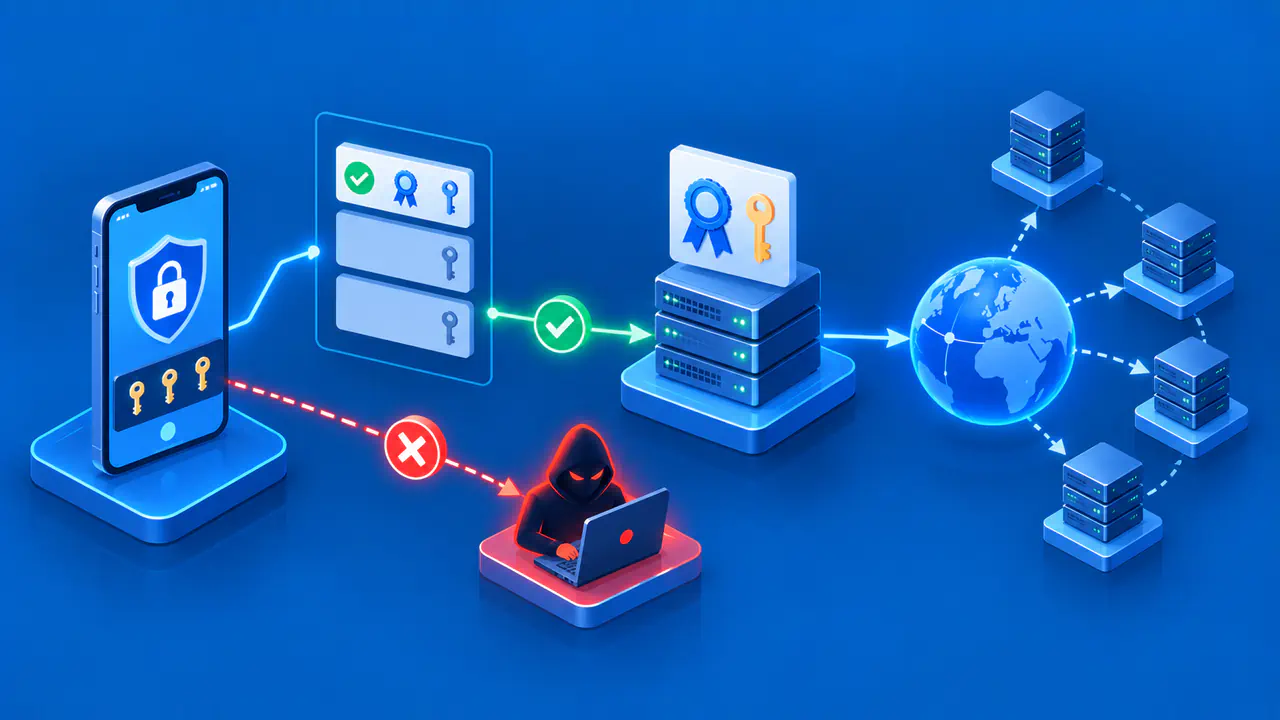
How Certificate Revocation Checks Work
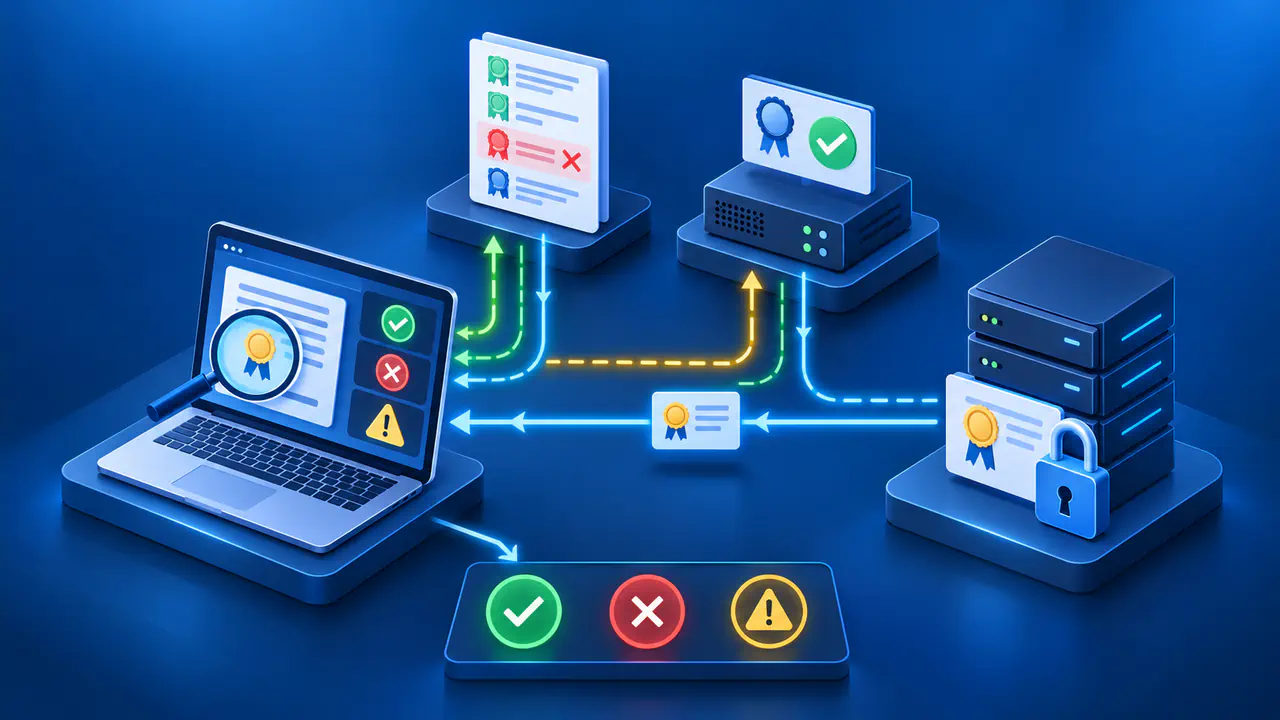
A TLS certificate has an expiration date, but its issuer may need to withdraw trust before that date. A private key might be compromised, a certificate might have been issued incorrectly, or the certificate holder might no longer be authorized to use it. Revocation is the issuer's signal that the certificate should no longer be relied on. A client can use published status information to decide whether a certificate is revoked while validating a connection.
The existence of revocation information does not mean every browser sends a live request for every certificate it sees. Clients differ in which status sources they use, how often they refresh them, and what they do when a source is unavailable. The certificate provider also determines which revocation mechanisms it provides.
Why a Certificate Can Be Revoked
Revocation lets an issuer withdraw a certificate before its scheduled expiration. The issuer identifies the certificate, normally by issuer and serial number, and publishes status that marks it withdrawn. This is distinct from a server simply removing the certificate: copies can remain available elsewhere, and clients still need a way to learn that the issuer has revoked it. Issuing a replacement does not invalidate the old certificate on every client. A client that lacks current revocation information may still accept the old certificate if its other checks pass.
A revocation reason may describe key compromise or another event, but client behavior should not be inferred from a reason label alone. The certificate owner should replace the certificate and protect or rotate affected keys as appropriate. A site operator should confirm that the public endpoint serves the intended replacement and that the intended clients can obtain usable status information. The detailed incident response depends on why the certificate was revoked.
How CRLs and OCSP Carry Status
A certificate revocation list, or CRL, is a signed list issued by a certificate authority or an authorized CRL issuer. It identifies revoked certificates within the list's scope and has update information so a client can judge whether the data is current. A certificate can identify a CRL distribution point. The client must verify the CRL signature, its issuer relationship, its scope, and its freshness before using it. The absence of a serial number from an irrelevant or stale list is not reliable evidence that the certificate is acceptable.
The Online Certificate Status Protocol, or OCSP, asks a responder about a specified certificate and returns signed certificate status information. The status values are good, revoked, and unknown. Before relying on a response, the client must check that it identifies the requested certificate, has a valid signature from an authorized responder, and contains sufficiently recent status information.
A validated revoked response tells the client to reject the certificate. An unknown response means that this responder cannot determine the status; it is not the same as good. Even good does not replace the separate checks for certificate dates, names, signatures, and permitted uses.
Fetching status over the network can add latency, fail when the responder is unreachable, and reveal a client's browsing activity to the responder. OCSP stapling can let a TLS server send a recent response during the handshake, where that feature is supported. Cached responses and downloaded revocation data can avoid a fresh query for each connection. Each design trades off availability, freshness, performance, and privacy.
Why Browser Checks and Failure Policies Differ
A client has to decide what to do if it cannot obtain a fresh status result. A strict policy may reject the connection, while a more permissive policy may continue under some conditions. Those decisions are implementation and policy choices, not properties of the CRL or OCSP protocol alone. A connection that succeeds during a responder outage therefore does not prove that no revocation exists. A connection that fails may reflect unavailable status data rather than an explicitly revoked certificate.
Chrome uses distributed CRLSets to block certificates in emergencies and also includes some other revocations. It generally does not perform online OCSP or CRL checks, although enterprise policy can enable online OCSP. CRLSets contain selected revocations rather than every entry on every CA's CRL. Firefox's CRLite system uses compressed revocation information on the device; its production rollout was introduced with Firefox 142. Another browser, operating system, enterprise client, or older version may use a different approach.
Testing revocation means identifying the exact client and version, its trust store, policy, available status data, and network conditions. Inspect the certificate chain as well as the status source. A TLS warning does not by itself identify a revocation problem: the cause could be an expired certificate, an untrusted issuer, a name mismatch, missing status data, or a confirmed revocation.
Check the Provider and Certificate You Actually Use
Certificate authorities do not all publish status in the same way. Let's Encrypt ended its OCSP service on August 6, 2025, and publishes revocation information through CRLs. Its newer certificates omit OCSP URLs. That change is specific to its service and does not imply that OCSP has disappeared from every public or private certificate authority. Software that assumes every certificate has an OCSP URL may need review.
When investigating a certificate, inspect its issuer and status-related extensions instead of assuming a generic provider setup. Determine whether the client uses CRLs, OCSP, a distributed revocation set, or another mechanism for that issuer. Check whether the data is current and whether the client treats an unavailable source as a blocking error. A status result for one certificate does not automatically cover every intermediate in its chain.
Replace a revoked certificate promptly and confirm that the public endpoint serves the replacement. Continue monitoring both expiration and revocation events.