Unicast vs Multicast vs Anycast
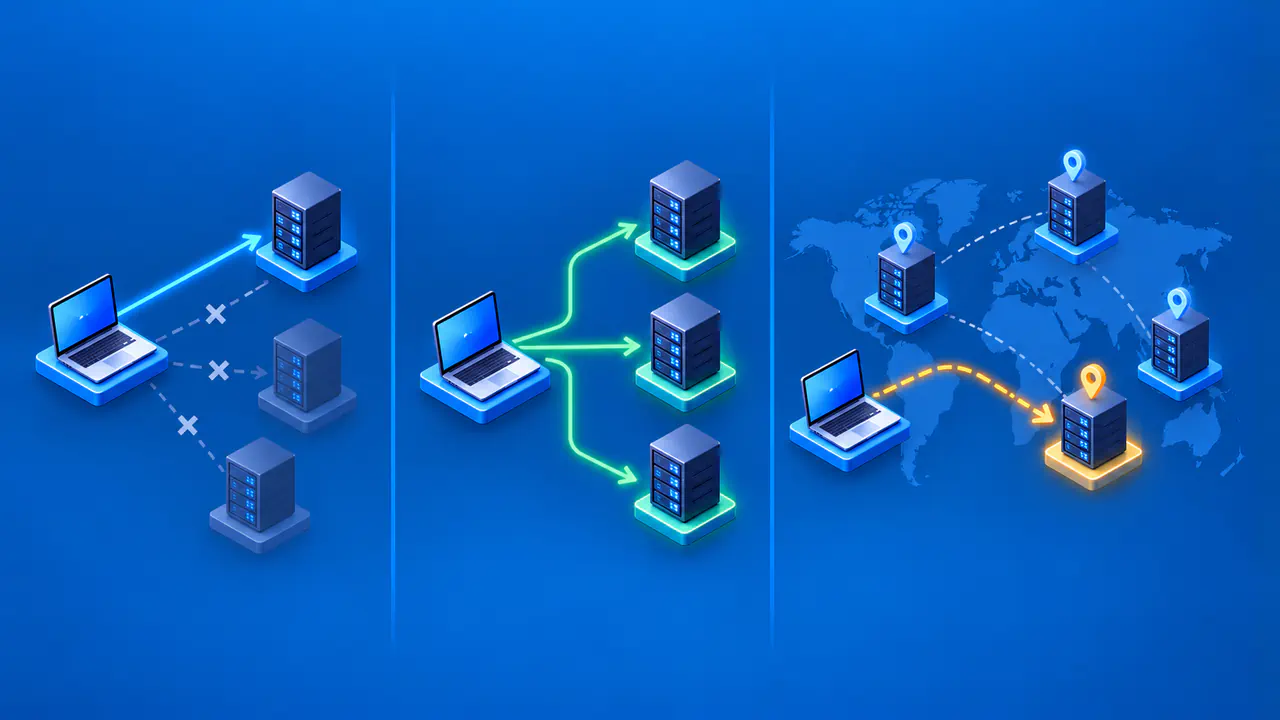
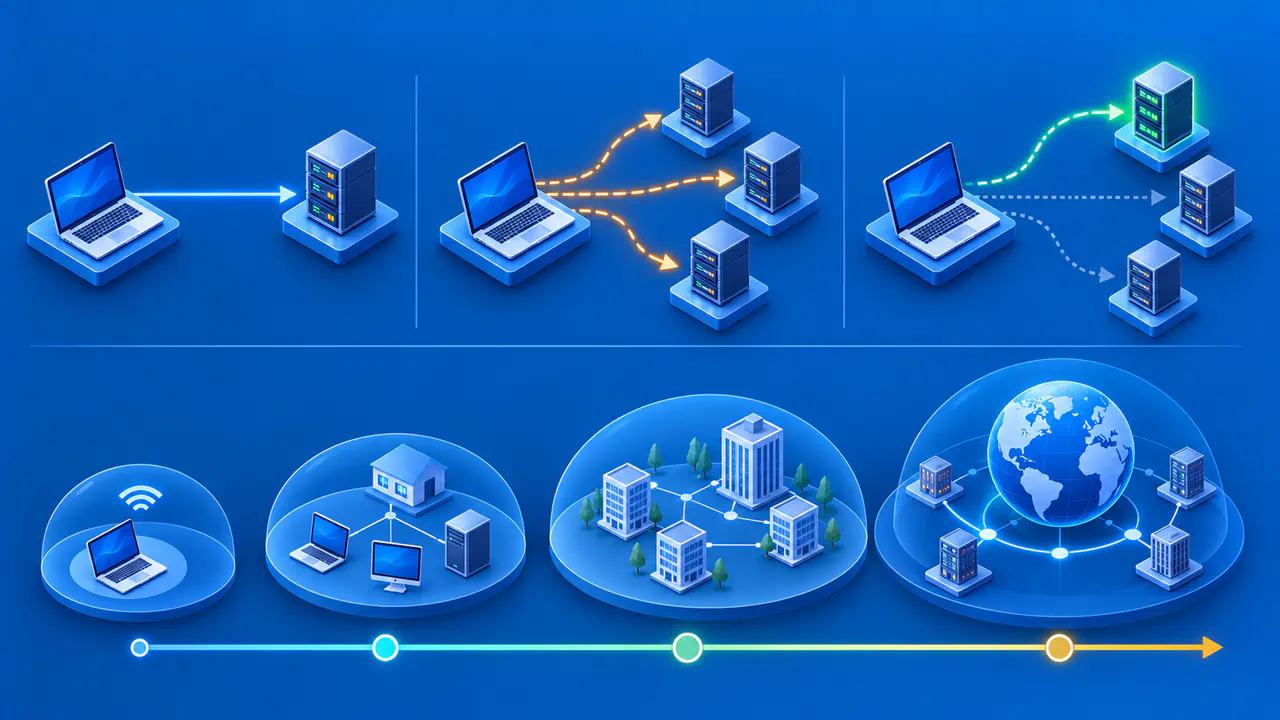
Unicast sends an IP packet to one addressed recipient. Multicast sends it to a group of interested recipients. Anycast uses one address at multiple service locations, with routing selecting one location for the packet.
The difference is in who should receive the traffic. Multicast is useful when several receivers need the same transmission. Anycast is useful when a client needs one available instance of a distributed service, rather than a copy from every instance.
These delivery models do not specify whether the application uses encryption, how it handles lost data, or what response it returns. Those properties belong to other parts of the service. Choosing a delivery model starts with the intended recipients and the network that connects them.
Unicast: One Addressed Recipient
A unicast destination identifies a single interface at the IP layer. A packet may pass through several routers on its way there, but those intermediate hops do not become additional intended recipients. Each router selects a next hop and forwards the packet toward its destination.
For example, a client might send a request to a server at 192.0.2.40. The server's reply is addressed to the client. Other clients can contact the same server at the same time, but their exchanges remain separate communications.
The Transmission Control Protocol (TCP) can provide each exchange with an ordered byte stream and retransmission when data is lost. IP unicast by itself does not supply those features. An application using the User Datagram Protocol (UDP) over unicast must still handle whatever loss or ordering behavior matters to its own protocol.
Separate exchanges are useful when clients request different data, start at different times, or need individual responses. Sending the same payload through ten unicast streams still means ten separate transmissions from the sender. Identical content does not turn those streams into IP multicast.
Multicast: Delivery to a Group
A multicast destination identifies a group rather than one receiving interface. Membership can change as receivers join or leave, and a group can have no listeners at a particular time. The destination address alone does not tell the sender how many receivers currently exist.
Multicast routing forms a distribution tree. A shared part of the path can carry one copy, with routers creating additional copies where the tree branches toward receivers. This reduces repeated traffic over shared paths when the receivers need the same data.
For an illustrative calculation, assume one sender provides an identical 6 Mbps payload stream to ten receivers. Ten separate unicast streams require 60 Mbps of outgoing payload from that sender. A multicast stream can carry the 6 Mbps payload once on its initial shared path, with copies made farther along the distribution tree.
The calculation excludes headers and other overhead. It also does not mean that the entire network carries only 6 Mbps: each required branch carries its own copy. The saving depends on how much of the route the receivers share.
Group Membership and Network Support
IPv4 uses the Internet Group Management Protocol (IGMP) to report multicast group interests to neighboring multicast routers. IPv6 uses Multicast Listener Discovery (MLD) for the corresponding listener information. These messages tell the local network which traffic receivers want.
Delivery across routed links also requires multicast forwarding along the relevant path. Protocols such as Protocol Independent Multicast (PIM) help routers build the distribution tree. Joining a group on a host does not, by itself, configure remote routers to carry that group's packets.
Multicast can serve a managed network distributing a common live stream or shared data feed. It should not be assumed to work across an arbitrary Internet path merely because ordinary unicast works there. Receivers must support multicast, and routers along the path must forward the group's traffic within its permitted scope.
Delivery is still subject to packet loss and reordering. A group transmission is not a promise that every member received every packet. The application must account for the reliability it needs rather than treating group membership as confirmation of successful reception.
Anycast: Routing Chooses a Service Location
An anycast service makes the same address available at multiple nodes. A client sends to that address, and the routing system directs the packet toward one node. It does not distribute a copy to every node as multicast would.
Anycast addresses use ordinary unicast address formats. An IPv6 anycast address has no special notation that distinguishes it from a unicast address. Recognizing an anycast service therefore requires information about its deployment and routing.
Google Public DNS, for example, is a Domain Name System (DNS) resolver that uses anycast to serve the same addresses from many locations. A query to 8.8.8.8 reaches one selected service location. It is not a multicast request for all the resolver sites to answer.
“Nearest” Depends on Routing
The selected node is nearest according to routing decisions, rather than necessarily being the closest building on a map. Network policies and available paths influence where traffic goes. Two clients in the same city may reach different service locations through different Internet providers.
A routing decision also does not measure every server's current response time before each request. Anycast can help distribute service access, but it does not guarantee the lowest application latency or equal numbers of clients at every node. The resulting traffic distribution follows the paths the network selects.
Service Health and Connection State
A route can remain available even when the application at its destination is unhealthy. Operators can connect service health checks to route advertisement and withdrawal so unavailable instances stop attracting traffic. Sharing an address does not create health checks or withdraw routes automatically.
Anycast can carry TCP services as well as UDP services. The important question for an established connection is whether its packets keep reaching an instance that has the required connection state. If a route change delivers later TCP packets to another instance without that state, the connection can be disrupted.
Long-lived connections are especially sensitive to a change of service instance. Stable routing helps keep their packets at the same instance, while the service must retain the state those connections need. Support for TCP does not imply that an established connection can move freely among unrelated service instances.
Choosing the Model for the Service
Choose the delivery model according to who needs each packet and how the service is deployed:
- Use unicast when a request or response belongs to one addressed endpoint, particularly when clients need separate exchanges.
- Consider multicast when multiple participating receivers need the same ongoing transmission and the network supports group delivery.
- Consider anycast when several locations can provide the service and routing should direct each client toward one of them.
A live feed on a managed network and a public resolver answer different distribution needs. The feed may need to reach many listeners with the same data. A resolver client needs one instance to handle its individual query, which can suit anycast.
One service can use more than one model at different stages. A front end may receive clients through an anycast address and then make a separate unicast connection to an origin server. The anycast choice for the front end does not turn its backend request into a group transmission.
Replicas must provide compatible service behavior, with consistent data wherever the service requires it. Routing selects a location; it does not synchronize the replicas. Use a replica's individual unicast management address to reach that node instead of whichever instance attracts traffic to the anycast address.